Tag Archives: Landscape Architects

‘Down But Not Out’ by Tom

Leaning tree on A272 near Sheet, Hampshire

Trees are great. Fact. They provide us with oxygen, shade, habitat for wildlife, timber for building, chemicals for medicines, screening, beauty, shade…the list really does go on. They have long been a symbol of permanence within the landscape, taking decades to grow to the lofty heights that we so admire. Yet it takes only an instant to cut them down and lose it all…

 Therefore, safeguarding mature trees is an extremely important aspect of a Landscape Architects work and we’re helped by ‘BS 5837:2012 (see Bernie’s previous post!). 25-30cm girth replacements are great but they’re just not the same and feel like a meagre offering when you’ve lost a tree with a girth of several feet. The value of a large mature tree should have the potential to outweigh that of one extra house squeezed onto a development plot, since a pleasant and good quality landscape encourages us to pay a premium for property. What’s more, trees can really mean something to people and I’m always amazed by how attached we can get to a plant that we have no real link to, simply because it’s part of our daily scenery.

 This tree is found on the A272 just outside Sheet. It hasn’t been felled, it’s just resting on its branches and has been for maybe 20 years now – as long as I can remember anyway. Consideration was given to cutting it down but people objected because it was so familiar and liked as a local landmark. The plucky tree that fell over but wouldn’t give up. What could be a better symbol that we shouldn’t be quick to cut down large trees? Trees inspire. Trees endure. Trees are great.

What’s in a name? – part II, by Martin

There’s nothing says that you’re in England more-so than a place name like ‘Crackpot’ (in Swaledale, North Yorkshire to be precise). One of the many joys of being a Landscape Architect is the need for us to explore, and when we do, we’re surprised by place names more often than you’d think. 

Happy Bottom, near Wimborne Minster

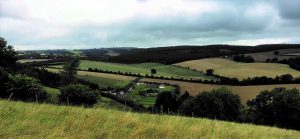
Viewpoint 44 of my VIA near Wimborne Minster

My recent Visual Impact Assessment of a proposed housing development in Wimborne Minster includes viewpoint 44, located at ‘Happy Bottom’. In the course of undertaking similar fieldwork, I’ve also visited ‘Scotland’ (near Liss, in Hampshire), and ‘Quebec’ (near Harting, in West Sussex). Out on the road I’ve been amused driving through ‘Worlds End’ (near Denmead, in Hampshire), and invariably on route to visit my Mum in Shropshire there comes a point when I’m at ‘Loggerheads’. When I first started out as a Landscape Architect, I did a design for a school in Wootton Wawen (in Warwickshire). Try saying that after a couple of pints. I would mention a favourite old Terra Firma scheme at ‘Sandy Balls’ (in the New Forest) – but we would not wish to cause offence to client, inhabitants or indeed the many who visit there.


Place names are a constant fascination to me. Not only do they often make me smile as I go about my work, but they nearly all (even the less amusing ones) make me reflect on the origins of the place. How do places become known by then names we associate with them? It would seem that it is rarely deliberate but often a quirk relating to some long-forgotten human intervention centuries back. 

Terra Firma's Visual Impact Assessment in West Sussex

Who said Quebec was in Canada? – It’s in West Sussex!

Human intervention is the very essence of the work of a Landscape Architect. A site we’ve designed including a prominent tree may have slipped our mind in 20 years’ time. But in that space of time, the tree may have become important in the minds of local people. They may associate it with the landowner. In another 20 years’ time, the landowner may sell the land and housing may be built on it. The tree may be kept, and the way people refer to it may stick. They may still call it ‘Mr. So-and-so’s tree’ – even though Mr. So-and-so is no longer around. The name might become synonymous with the place, not just the tree. After all, it’s believed that the Saxon origin of the name ‘Coventry’ is derived from ‘Mr. Cofa’s Tree’.


Once upon a time, somebody made the decision to plant some Oak trees – 7 of them. Eventually, that place became known as Sevenoaks. Or on a more local scale, sometimes you’ll come across street names referring to a tree. Even though ‘Elm Grove’ may no longer have any Elm trees, at some time in history somebody would have decided to plant the trees that gave the place its name.


Place names are littered with examples of how our predecessors have designed Landscapes in the past. Without knowing it, we might also create history in a similar way – a way that is almost indelible. Something which makes a ‘place’ different to a ‘plot’ is when a community collectively gains a perceptive association with it – and for ease of conversation the location often becomes intrinsically referred to by name. This possibility that an echo of our day-to-day designs could resonate long into the future (long outliving the original creations themselves) is all the more intriguing because it’s a quirk of fate, out of our hands. It’s a joy to think that our designs can take on a life of their own.

Sixteen Years On

This month is the sixteenth anniversary of my joining Terra Firma (and actually Robyn’s 17th though she subsequently has had a couple of short periods of ‘time out’ – maternity and working elsewhere). Amusing to reflect on what has happened over that time, though less so in terms of how one ages each team photo. We have just updated the website with such today along with a few other things across the board.

August 2012; Alison, Martin, Lionel, Ally, Paul, Robyn, Tom and Isla

In 1996 there were just four of us working out of small but very pleasant and characterful offices the other side of Petersfield. Terra Firma’s founder, my new business partner John Wigham had moved the small firm up from Portsmouth the year before to be a little nearer London and the traditional hinterland of Terra Firma’s clients from its eleven years of existence. To be frank, the firm had been through a pretty turbulent boom and bust history in its first five years at the end of the 80′s and it was something of a phoenix rising from the ashes, albeit building from some solid foundations – terra firma even.  Getting a partner aboard was as much John’s ‘game plan’ for making a gradual exit from practice (4 years later) as it was mine to start running my own thing.  Thankfully it worked well for us both.

1996; John Wigham and Lionel at the old offices in The Spain, Petersfield.

It is sometimes hard to remember that back then computer technology and the web was still in its early days within the profession, as were a lot of the now universally accepted practices of EIA, Green Infrastructure and sustainable technologies.

An early Terra Firma project, Hampshire Corporate Park, twenty years on in 2007.

Sixteen years on and the workload of schools, residential and healthcare with the occasional business park (and one or two quite  high profile ones both here and in the USA to be fair) has expanded to large scale strategies, masterplans and assessments with projects all over the world. We have just this week been appointed to a project in China, our first there and the 22nd country in which we have now operated. This is never to forget our roots here in the UK or with smaller projects which can be just as challenging.

UK map locating TF projects in last 5 years (with apologies to Dalcross for being cropped from the top!)

Alshamsi Terra Firma directors Lionel, Alistair and Jamie outside the Petersfield Offices August 21st.

It is hard to gauge where the world economy will take us all but currently it really is is ‘full on’ both here and with the Dubai office at the moment, and on target for the best year in the firm’s history – somewhat at odds with what one reads in the press but with fingers crossed we will be making the best of it.

With best wishes to you all

Lionel    August 2012

My analogy-tastic landscape head

It’s no secret that I’m into historical stuff. My mind often drifts that way, as it did when I was thinking about what to write in this blog. For me, the act of being in a place that resonates the past really fires the imagination. My daily commute to work involves a walk down a 10th century drove road, with a ‘magan’ (a bank and ditch marking a Saxon parish boundary) on one side, and an ancient semi-natural woodland on the other. I find it amazing to think that the first humans to walk the route which I walk were 44 generations before my own. In theory, it could have been my Great X 41 Grandfather who originally set out the track. My walk to work is tranquil, and at the same time it fires all of the senses. It’s a start, and an end to my working day which is beyond valuable. There’s something about it which is simply magical. 

Historic Landscape at Rowlands Castle

My daily trudge to work - horrid isn't it?

As a landscape architect I am in awe of places which invoke so much sentiment. In fact, I’d go as far as to say that no design can match the intangible depth of history, and I have to admit that as a designer I can’t compete. However, landscape architecture isn’t just about design. I was recently walking in the Royal Forest of Bere – another ancient semi-natural woodland near my home. Reminded that landscape architects are custodians of the landscape, it occurred to me that that might mean creating interventions befitting of the modern era, or it might equally mean looking after interventions from a bygone time.

As a designer, I don’t just look to the future – I like to keep one eye on the past. In the future my modern-day interventions will be considered as just another stitch in the ever-growing tapestry of history. Everywhere you look there is another thread in that tapestry – and each one tells a story. Some threads are short-lived – others have weaved from a point way back in history, and will go on into the future. Looking to the example of past interventions can help us consider how effective our proposed interventions might be.

This is why it is important for landscape architects to be skilled not only in design, but also in the practices of managing the land. There are some places where design is not the priority – if it denies us an ancient landscape that has much to teach. If I were asked to design a modern-day intervention for an ancient setting, I would make sure that my design respected the pre-existing threads in the tapestry of history. Moreover, as landscape architects we sometimes have the privilege of inheriting a weave started before us, and seeing it continues into the future.


Happy days, Spring is almost here! By Tom

Spring has sprung,
the grass is ris’.
I wonder where the birdies is?
The bird is on the wing,
but that’s absurd.
The wing is surely on the bird!
- Anonymous

Ok, so it’s not spring just yet. It’s a fun little verse though, no matter which version you know, so why not deploy it a touch early…especially when the signs of spring are bursting out all around? Bulbs pushing through the still frosty ground…morning birdsong growing more buoyant by the day…dormant buds tentatively unfurling to test the air…all bringing with them an overwhelming sense of relief that the coldest, darkest days of the seasons are behind us once more and we can look forward to brighter mornings, longer evenings and a curious abundance of chocolate eggs in supermarkets as the coming season shoves its foot in the door and tells winter it’s being evicted.

For Landscape Architects spring can be a real mixture of challenges and pleasures: landscape and visual impact assessments become more difficult as foliage starts to obscure views; Contractors, Clients and Project Managers feel the pressure of finishing planting jobs before the end of the season, often at a time when the weather casually alternates between too cold and too wet.

But it’s wonderful to watch the landscape leaf up, a lush patchwork quilt nestling over the land, draping town and country alike in green until they resemble the landscape masterplans found on our drawing boards. It’s always exciting to see dormant planting designs come to life, gradually punctuated with vivid interruptions of colour which constantly change as the months pass.

It’s invigorating to become spurred on by the approach of summer, filled with the promise of landscapes brimming with life as everyone makes the most of the warmest months of the year. Every season has something to offer, but many would agree that spring has the most potential to be uplifting. A new beginning. A fresh start.

Let’s try to pause now and again, look around, take in the opening buds, the brave little bulbs, the cheerful birdsong, and enjoy the onset of the new season and all the promise it holds, looking forward to the rest of the year. Oh, and if you time it right, discounted chocolate eggs.

Not quite time yet, but we're ready and waiting

2012: Landscapes of the future

I was recently on a flight toBarbados (just had to get that in) and I was reading ‘predictions for 2012’ in the on-flight magazine. Several ‘experts’ independently see this new year heralding a mass yearning to get away from the fast-paced digital age and experience something a bit ‘rustic’. People will want to visit places where their Blackberries don’t work. Apparently there’ll be new markets in more adventurous tourism, with people wanting to explore places that have never appealed before. I expect that going somewhere without the luxury facilities we’ve demanded in the past will also be a bit cheaper – perhaps not a coincidence. Continue reading